


press articles- uk music papers
Drum
Magazine
1974
1974

Barry
Pike:
A rock and roll band is just a whacking great rhythm section
 Barry
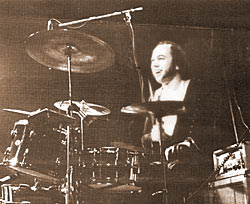
Pike plays drums for Fumble, one of Britain's best and most authentic
rock and roll revival bands. Some years back, he played in a blues/soul
band led by his brother Jeffrey - who is now, as it happens, Assistant
Editor of our sister magazine Guitar. We thought it would be a good
idea for Jeff to interview Barry: guitarist/journalist Pike talks
to drummer Pike.
Barry
Pike plays drums for Fumble, one of Britain's best and most authentic
rock and roll revival bands. Some years back, he played in a blues/soul
band led by his brother Jeffrey - who is now, as it happens, Assistant
Editor of our sister magazine Guitar. We thought it would be a good
idea for Jeff to interview Barry: guitarist/journalist Pike talks
to drummer Pike. JP: Care to blind me with the technical specifications of your present kit?
BP: It's a black Slingerland kit, the first plain black one they made, apparently. They called it Black Beauty. It was also one of the first kits with a 24" bass drum they exported to Britain. The small tom-tom is 13" x 9", the floor tom-tom 16" x 16", and I use a 6"deep Ludwig metal snare drum. I've made a few changes to the drums, fitted Hayman legs to Ludwig - they're very expensive but very good. All my pedals and stands are Hayman. My hi-hat cymbals are Paiste and I've got a 16" Paiste 2002 as a small crash, a Zildjian 18" for a large crash and a 20" for ride. I use Hayman 'C' sticks, because they're cheap; I buy a dozen pairs at a time and throw away any duff ones. It's still a cheap way of buying decent sticks.
You've got a new Slingerland kit on order: what does that consist of?
Basically, it's two inches larger all round, a 26" bass drum, etc. the floor tom-tom is very big, 18", in fact it's got four legs. I'm getting a drum board made, so that my kit is set up exactly the same every night. Chris (one of Fumble's two road managers) knows it fairly well, but even he sets it up with one or two things slightly out - if the tom-tom angle is 1" out, I have to change it. So it will be all marked out on the drum board - just a great lump of 7-ply or something, hinged in the middle so it will fit in the truck, with holes in it for the bass drum legs and raised bits for the cymbal stands. The whole thing will be so solid that you can set up the kit on the side of the stage - if the stage is big enough - and I can sit on it and make sure everything is right; then it can be wheeled on when it's needed. Among other things, it will stop bass drum creep: on some rickety stages, even the Hayman legs with those points on can't hold it steady.
Do you still use that old mail-bag to set things on?
Oh yes - that thing with the metal rings at the corners. The legs go through those and the stool sits on the bag. That's a great anchor, I've lent it to so many drummers. It's got a great hole in it now, where the pedal goes - and that stuff takes ages to wear out. I only once had trouble with it at the Customs: it still had GPO on it and the fellow said it was Her Majesty's property. I think he was going to confiscate it and send it back to her.
It's not usual for drummers to change to fewer drums on their kit: when did you change from having two small tom-toms, and why?
That was when I got my present Slingerland kit, 2 1/2 years ago. I missed the two tom-toms, but at the same time, it was nice to have a ride cymbal in really tight - it comes up from the bass drum, where the second tom-tom used to be, and really low. I've got a lot more things out of that. I'd still like to get back two tom-toms, because the ride cymbal has grown in height over the last year. I don't know if the new Slingerland fittings will allow two tom-toms be close enough together for me. I might end up with one fairly central on the bass drum and the other on a snare drum stand by the side of it. I've always liked a tight kit, everything close together. I've had the snare and the floor tom-tom close to each other: that's why I wear out 'my trousers at the knee - my right leg is always sandwitched between two drums.
I'm looking forward to my new kit arriving: I'll be able to set up a double kit and experiment. I can get to rehearsals two hours before everybody else, because they're always late unless something really good comes out of it. If I had a couple of hours every day just to think it all out, I'm sure I could work things out with two bass drums. Once you get used to it.
It doesn't matter whether it's something I've used before, or something I've nicked, as long as I've decided it's right for that song. That's the real satisfaction. Then there's the satisfaction we get on stage from a good gig; it's a great outward-going thing. Sometimes on stage I just sit there and watch the people bopping and smiling, and I get a hell of a kick out of that. That's why I sit there with a grin on my face (as confirmed by the photographs, taken by Jeff at the Marquee: Ed.) Then we go into another number, and I think to myself, 'Ah, I enjoy this one,' and I play some nice drums on it, I try to think of new things for that number. Whenever that happens, I don't just gaze at the audience, I lose them a bit, though I'm still aware of them being there.
But it must be limiting on a musical level to work always with simple rock and roll material. You may think of a fantastic fill, but it just won't work with Fumble...
You're only efficient as long as you're beneficiary to the music, as long as you're complementing it and adding something to it. Anything very tricky just wouldn't coplement the music the lads are playing unless it was very, very well worked out. If I could do it in this framework, I'd be a very good drummer.
So isn't it frustrating to work in this framework?
What I'm doing now is a rhythmic thing that I enjoy. It's nothing to do with improvising and throwing ideas backwards and forwards - if I tried to do that, I'd be a bad drummer in this band. There's a great basic satisfaction about playing such a pure rhythmic thing as rock and roll. And playing the same song every night especially the simplest ones, it's not exciting to me just to play it. I have to make it exciting for myself, to give it that push and drive, without necessarily filling in a lot, but just by the way I approach it. It's important that I enjoy it every time.
But... you've been playing 'Take Good Care Of My Baby' for three years: surely you can't do anything more with that, can you?
No I can't. But I just accept it as 'Take Good Care Of My Baby'. I play the drum part and I sit there thinking, 'Here we are, playing Take Good Care Of My Baby.' If you like, the drummer in me leaves off and I'm sitting on stage enjoying watching people enjoying 'Take Good Care Of My Baby'. And then on the other hand we do 'Party', which gives me a nice chance to do drummy things, and I'm a drummer again.
Are you playing anything more on drums than you were three years ago? Have you learned anything new as a drummer?
It's like learning a language. You suddenly find yourself saying something you didn't know you couldn't say. You put sentences together and maybe use words that you've never used before, although you knew that they were around. It's like that when I jam with anyone else. What I do on stage is what I see in my role with Fumble, I do what's needed for Fumble. But when I'm just messing around, like in rehearsals, I find I've learned the language and I can say new things that I'm not called upon to say with Fumble.
With you, actually playing the drums is just a part of belonging to that band, right?
Yes, the social thing is very important for me - obviously, since we've played together for 6 1/2 years. I've got to be in the right social surroundings. Fumble to me is not just four other people; there's probably 200 people connected with the group who are very good friends. There are some bands that I see on stage and I think, 'Great!' Then I go backstage to see them and I think I could never in a million years play with those guys. On stage it would all be happening, but off stage I'd have to come out and get a taxi and leave. I couldn't exist with those people socially.There are a lot of good musicians, guys I'd like to play with...but it's got to work out on a social level as well.
Because that comes across in the music.
 facebook
  Guestbook
 Contact